Digital Product Passport registry is live: how can we get the best from this new innovation?
The central registry for the EU Digital Product Passport goes live this month.
From the 20 July 2026, the central registry will open for the first wave of product categories, marking the EU’s push to make sustainable products the norm across the single market.
How do Digital Product Passports fit into the Ecodesign for Sustainable Products Regulation?
Digital Product Passports (or DPPs) are a core part of the EU’s Circular Economy ambition, and sit within the Ecodesign for Sustainable Products Regulation (ESPR). The ESPR replaces and extends the reach of the former Ecodesign Directive by including new product categories textiles, car batteries, furniture, electronics and tyres.
The ESPR sets out the eco-design requirements for sustainability such as energy efficiency and durability that manufacturers must meet if they want to sell in the EU market.
These requirements will not just change the way products are designed and produced but how they are managed throughout their lifecycle – and this is where the DPP comes in.
How can Digital Product Passports help create a more circular product system?
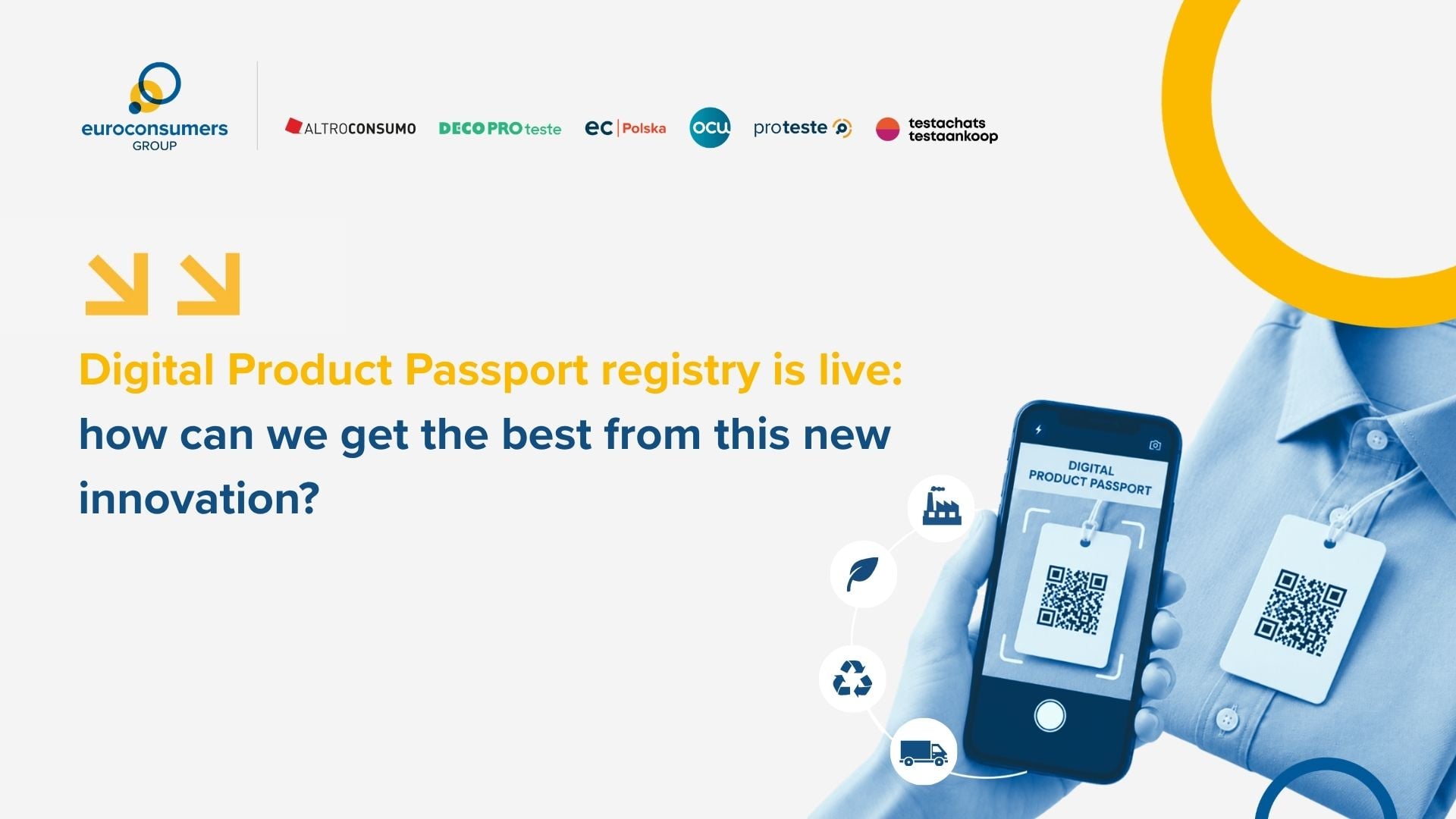
The DPP will give certain products their own ID linked to product information which consumers will be able to access by a QR code at the point of purchase and throughout its lifetime on how to repair and recycle the item.
The information in a DPP would also be accessible to repair professionals to easily access key information like repair options, materials and spare parts, while helping consumers better understand the product repair history.
What could help or hinder Digital Product Passports?
DPPs could be an innovative forward step that joins up the supply and demand side of the product market, and opens up easier access to repairs.
However, changes of this scale are inevitably challenging. Through Euroconsumers’ consumer-centered repair projects, policy work and stakeholder discussions some unique insights some of the sticking points of the ESPR and DPP and how its roll out could improve:
Any initiative aimed at getting broken products repaired instead of going to landfill needs a mindset shift towards a repair economy where repair is the default option, which was the main goal of the Rep-per project. Accessing quality information on products, usage, maintenance and repairs is critical for sharing knowledge and growing a repair culture and the DPP will help with this for some products. But at the moment,costly repairs stop consumers getting things fixed so cheaper ecosystems of repair services need to be developed to make circular economy initiatives work as intended.
Euroconsumers’ pilot testing of DPPs with consumers through the CIRCTHREAD project found it was critical to get the right information, in the right format at the right time in order to encourage people and reward new, more sustainable choices and usage patterns. Without careful user testing, engagement and understanding could be lost.
Euroconsumers Start Talking March 2026 webinar took lessons from the REPper project which explored how DPPs could help Europe deliver on its repair promise. The participants’ views on DPPs varied, some acknowledged their potential to transform repair and reuse by giving consumers clearer information on faults, repair options, and local services, while also helping repairers identify common failures and improve dialogue across the sector. Others stressed their usefulness for second‑hand markets and product maintenance. But there were concerns that the tool will not apply to most everyday electrical and electronic goods for many years, despite the need for faster action. This ties back to the consumer testing of DPPs, which people felt would be most useful for tech products, appliances and vehicles, where continuous repair and maintenance tracking is needed.
The multi-stakeholder Euroconsumers Forum also heard broader concerns about timing, as the new ESPR design rules and measures won’t be applicable until 2027. For DPPs, the first mandatory DPP will be the battery passport in February 2027 which will act as a proof-of-concept for the entire system, textiles and iron and steel are expected to join after delegated acts and compliance timelines in another 18 months to two years.
Digital Product Passports for the circular, sustainable economy
Euroconsumers is pleased to see the launch of the registry after many years of work to improve data flows, product markets and the ability of consumers to choose durable, sustainable and repairable products.
❜❜
The role we want to play is being an enabler of this value chain, helping companies’ by doing consumer pilots and testing of DPP and incorporating consumer needs. We hope to improve consumer awareness about ecodesign and energy efficient products and at the same time work to support companies’ compliance, thus contributing to market surveillance. This is why we also committed to Circular intelligence association, network and competence center for enhancing product information about circular economy. So stay tuned!
Luisa Crisigiovanni, Euroconsumers’ Head of Fundraising & EU Projects Development
As the Repair Directive moves into national legislation, Euroconsumers’ roundtable explored how prepared European countries are to build a truly repair‑friendly market and cult
International Repair Day: Euroconsumers members celebrate the power of repa...
Euroconsumers’ members are part of the REPper project and the 2025 Repair Festival - both are helping to grow a new way of thinking about repair and reuse.
CircThread study: How to make digital product passports work for consumers
Can Digital Product Passports help consumers choose and use products more sustainably? The results from pilot studies by Euroconsumers’ members Altroconsumo and OCU are in.