
News
24.03.2026


Too much focus on the supply side of energy in Europe system has left people without the market power they need to build a fair and resilient energy system. Next to that, ongoing attempts to empower people in the aftermath of energy crises have proved ineffective against the scale of the market challenge.
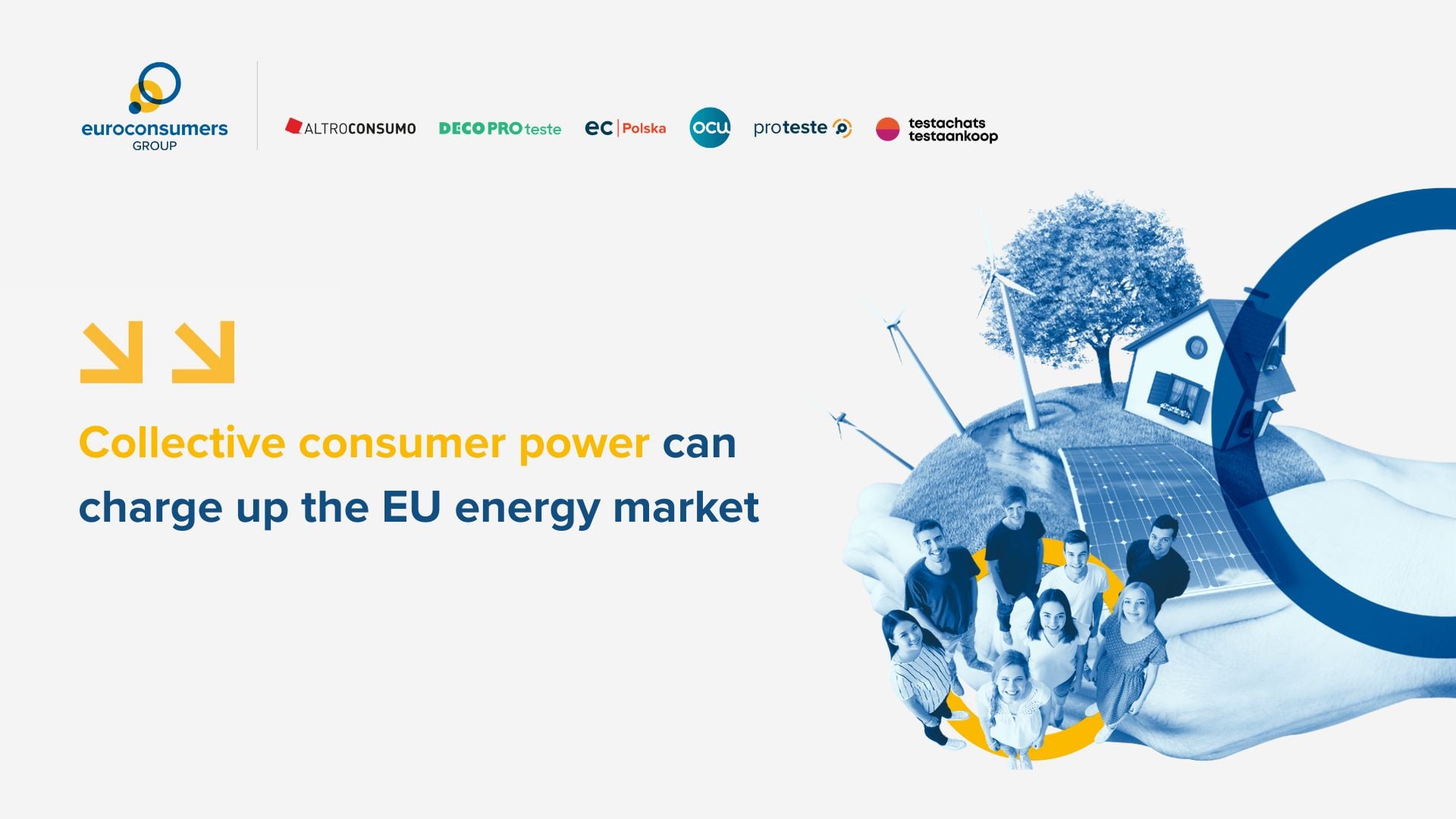
Euroconsumers’ new paper The power that sparks: Collective consumers shaping the EU energy market sets out the size of the affordability challenge, how collective consumer power can be a structural solution.
It unpacks how European‑scale purchasing, transparent pricing, coordinated demand response and energy communities can mobilise consumer demand alongside supply side reforms like electrification and grid investment.
Repeated energy crises, such as those caused by conflicts in the Ukraine and Middle East have left consumers exposed to rising energy bills, inflation and reduced purchasing power. Energy price spikes cascade into food via fertilizer costs, transport and manufacturing costs.
Even before the World Bank posted a 40% rise in its energy price index due to the latest middle east crisis, millions of households were struggling with energy bills.
Euroconsumers research found 28% of households in Spain and Portugal found it difficult to afford their energy, rising to 40% in Italy.
Energy costs in related sectors are also high: two in five households were struggling to afford meat, and over 25% of people found every day grocery costs difficult to afford.
Although some countries have abundant supplies of renewable energy which could power electricity supply, market design still mostly links the price of that electricity to that of fossil fuels.
Switching advice, temporary price caps or social tariffs may slice something off surging bills, but they do nothing to change the impact of households bearing the costs of volatile fossil-fuel markets with little influence over how the whole system works.
Before we get to what consumer power can do, here’s a reminder of the state and EU level job to be done to tackle our reliance on fossil fuels, which is the fundamental vulnerability that makes energy crises so damaging.
Renewable energy will reduce exposure to fossil‑fuel volatility, but production investment must be matched with modern grids and storage to end connection delays and the risk of blackouts.
Likewise, the electrification of energy-heavy consumer users like cars, heating and cooling through rolling out heat pumps and EVs is essential to reduce dependence and must be sped up.
But these roll outs must be fair and not alienate those on lower incomes who cannot afford or access these products. Getting this right with targeted support through subsidies, loans, social leasing and clear, workable policy design are essential.
A resilient renewables system, a robust energy grid and fair electrification will be a strong base for collective consumer power and action.
To achieve electrification, competitiveness and affordable energy security, the European Union must now give equal priority to building up the consumer demand side into a force for influence and change.
This starts with rewriting all policy with consumers in a leading role, not sitting silently in the audience. Here’s the changes consumers need to be active market participants:
1. European‑scale consumer demand architecture
Collectively, millions of households represent purchasing power that suppliers have to compete for.
Collective purchasing schemes bring together large groups of consumers via an intermediary organisation to leverage their combined demand and negotiate better prices with suppliers. Our members have tested how these schemes work nationally CLEAR‑HP heat‑pump group buys.
We know the bigger the aggregated demand, the bigger the impact and so want to see EU‑level consumer buying pools that group household demand across borders in much larger communities of scale. This would mirror industrial pooled demand and give households a level of negotiating power on a par with large commercial buyers.
Europe is building more integrated energy markets, cross border infrastructure and European-scale electricity supply – building the participation capacity of the consumer side of that market makes sense.
2. Transparent energy retail price information
Wholesale price drops happen but take their time to reach bills and don’t often translate in full to consumer bills when they do. Despite efforts to make pricing transparent, for example, Belgium’s CREG indexation data and Poland’s regulated tariffs, there is still not enough clarity on the relationship between suppliers’ underlying energy costs and the retail energy prices they bill consumers for.
If the relationship between wholesale market moves, suppliers’ procurement costs and the final retail price was more visible, consumers could better use their power to reward responsible suppliers who pass on savings.
National regulators need harmonised supplier information to assess price pass-on consistently across contract types and over time. Consumers need binding, harmonised, consumer‑friendly transparency on how suppliers’ costs translate into retail prices to be able to compare the full supplier offer.
3. A way to co-ordinate the demand response
Encouraging individual behavioural change like turning down the thermostat has never been enough. Consumers need to work together in concert to have a real impact on market prices and grid stability. That doesn’t need to be complicated, or for everyone to become an energy system expert.
Instead, a sophisticated automated demand response approach based on price and grid data drawn from flexible tariffs, aggregators and smart appliances can get cheaper energy on an hourly basis to people with minimal effort on their part.
However, the inputs that feed into demand response need to be right. Consumer facing products like smart-meters, EVs and other mechanisms such as dynamic contracts need to be properly assessed to see if they are working for consumers or failing them.
Simple, trusted and rewarding routes for households to participate in innovations around energy management are also far missing.
Consumer organisations are well placed to help provide that route at scale by mobilising households, explaining the benefits and risks, protecting their interests and organising participation, whether directly where appropriate or in partnership with qualified aggregators and technology providers.
4. Growing energy communities
Energy communities produce, store and share renewable energy locally and give households a direct stake in the clean energy and insulation from price shocks. This goes further than the collective purchases of a supply, and enables consumers to own a piece of local energy generation.
Energy communities are the best option for households with low electricity use or high gas dependence, but so far uptake is far below EU targets.
Euroconsumers’ members found that making collective energy opportunities work in practice means removing any unnecessary administrative, financial or rid barriers and ensuring that tenants, apartment residents, vulnerable households and other consumers who cannot invest individually are able to participate.
We’d also recommend consumer organisations to act as the trusted intermediaries needed to organise participation and help deliver back the value and benefits to consumers.
The Electrification Action Plan and the forthcoming Post-2030 Energy Union Package will shape the next phase of Europe’s energy transition. And as a transition that ultimately depends on millions of consumer decisions, it must be designed with consumers around for them.
The decades building the supply side of the energy system now needs to invest in and build up the demand side.
Over 450 million European households already represent significant economic power, but that power remains largely fragmented. The EU should support consumer organisations in organising and mobilising this collective power at scale, so that consumers can participate more effectively in and help shape the energy market.
Achieving electrification, competitiveness, and energy security will not be possible without understanding the full potential of collective consumer power as a practical, structural tool to make the energy market fairer, more resilient, and more effective.
Organised consumer demand is an economic asset that can help make the European energy market work, compete and thrive. Consumer organisations should be involved in their implementation and development to spark collective power and re-energise a fragile system.
Share:


After the Iberian blackout, Euroconsumers, OCU and DECO PROteste want an Energy Grids Package that delivers a resilient, interconnected system that consumers can rely on.
The CLEAR-HP project will simplify the path to becoming a heat pump owner and help over 40,000 consumers benefit from efficient, well-running heat pumps.
Read More