


Greenwashing is driving consumers away from sustainable finance investments
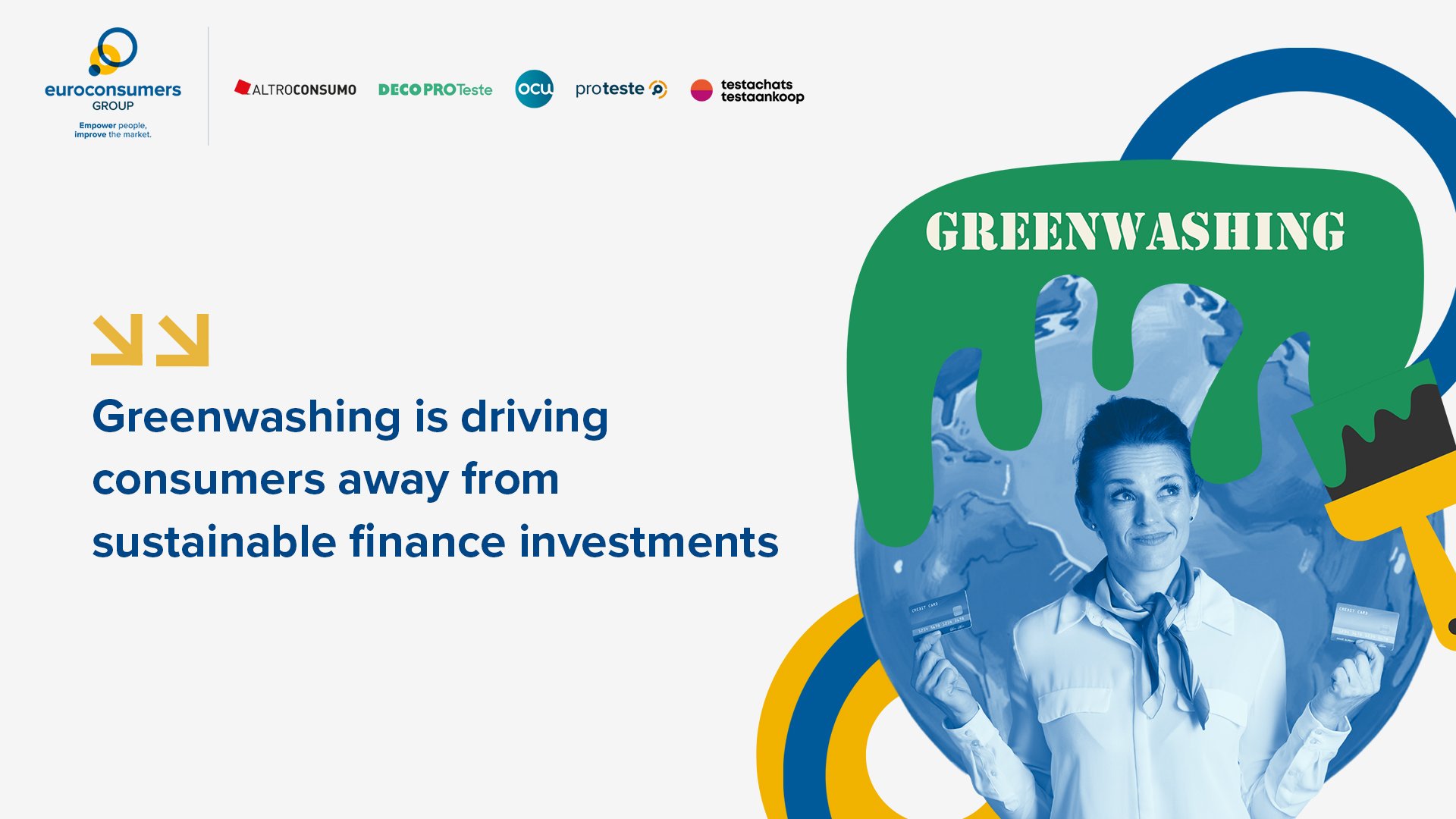
Europe has a big proportion of retail investors trying to grow their money through savings and investments. So there’s a real opportunity to encourage investment in sustainable funds, which have the double advantage of rewarding consumer investors and progressing social and environmental goals.
If options for investing this way are designed and communicated well, consumers will be empowered to make informed choices about how to make their money work hard. They can then actively contribute to improving the market for a more sustainable future.
At the moment, consumer retail investors face a daunting market of complex products and noisy marketing that can impair decision-making. In this crowded environment, concerns have been raised that misleading ‘greenwashing’ is actually deterring consumers from opting for sustainable investments at the very time it could benefit investors and the wider world.
The European Commission has plans in place to review the Sustainable Finance Disclosure Regulation (SFDR) to tackle greenwashing in sustainable investment products.
New research from Euroconsumers will feed into this review with a deep dive into consumers’ views on sustainable finance to get a better understanding of their experiences to date, and expectations for the future.
The survey of 4,193 consumers in Belgium, Italy, Spain and Portugal (see full methodology below) shows that people want sustainable finance to deliver genuine value without the greenwashing and glossy marketing.
This blog sets out the key findings and makes some suggestions for improvements to the Sustainable Finance Disclosure Regulation to empower consumer investors and activate a vibrant, trustworthy sustainable finance market.
The lowdown on consumers and sustainable finance investments
1. A savings habit and real potential for sustainable options
Consumers understand the need to save or invest, and across all four countries 79% put away money in some way.
On average, just over half of people asked (53%) made use of savings or investment products (as opposed to regular bank accounts or keeping cash at home), a proportion that was highest in Belgium (68%) and lowest in Italy (39%).
Yet most people have never saved or invested in sustainable finance products. We found the highest proportion of those that had lived in Belgium (18%), in Italy, Spain and Portugal it was around 1 in 10.
But there was an appetite for sustainable finance products – of everyone surveyed, 40% said they would consider investing in sustainable products, a share which rose to 81% amongst people who had already used sustainable finance products.
And two thirds of people believed every retail investor should have the opportunity to invest in a product.
2. The chance to make a positive impact appeals to consumers
Consumers are interested in sustainable finance for a variety of reasons but they are all related to a straightforward expectation that their money will make a positive difference while it grows for them.
Those who were considering green or sustainable products were motivated by investing in companies, sectors and activities that:
- • Would have a positive sustainability impact: 89%
- • Are transitioning away from high-emissions to low environmental impact: 75%
Consumers also wanted to reduce harmful impacts and so said they would avoid investing in:
- • Companies or activities that support fossil fuel expansion: 61%
- • Companies with socially harmful practices: 61%
This suggests that while achieving sustainability goals involves multiple factors, consumers have a clear sense of which priorities matter most and what outcomes they expect their investments to deliver.
3. Consumers don’t feel well informed about sustainable investments
The clear view consumers have of what they want from sustainable investments is not matched by the information they have about products.
The survey showed that sustainable investors felt less informed about sustainability aspects compared to financial aspects of products.
This creates an environment where misleading marketing could thrive – if consumers don’t feel informed, it could put them at a disadvantage when choosing between products on the market.
4. Marketing of sustainable finance products is causing problems for consumers
Decision-making is also made even harder by the way products are marketed. The survey showed that sustainability or green terms in the product name influenced people to different degrees.
Almost 9 out of 10 (89%) of people who were or had been sustainable finance investors said they were influenced by the name, with 30% saying it had a lot of influence.
The problem is that more than a third of respondents (37%) across all four countries who were faced at least once with a product that was in fact not sustainable or less sustainable than claimed, were investors who had taken the step to invest sustainably. Either the product lacked clear sustainability criteria, or didn’t match their expectations of sustainability, or made exaggerated environmental claims.
This real life experience is mirrored in the reasons people give for not choosing a sustainable product:
Just over a third of respondents (34%) gave misleading, unverifiable and unreliable green claims as a key reason for avoiding sustainable finance products. 40% of Italian respondents gave this as a reason, the highest compared to 30% of Portuguese.
5. Consumers expectations vs the reality for green claims trust systems
Consumers have clear and high expectations for green claims and the system that supports them:
- • 78% of respondents from all four countries want sustainable finance products to be subject to strong rules about what can be defined as “sustainable”.
The same proportion thought supervisory authorities should take action against any financial services providers selling misleading products.
- • 70% of people felt sustainability claims about financial products should be backed up by scientific data, and 72% agreed that verification labels backed up by independent tests were needed for sustainable investment products.
But how close are these expectations to reality? Unfortunately, a lot of consumers’ trust in the current framework is misplaced:
- • Two thirds of respondents have high or medium levels of trust that these products comply with strict sustainability laws, and 62% trust they are verified by a supervisor – which is not the case.
6. Greenwashing will harm sustainable investment growth
Our survey showed that misleading marketing or exaggerated claims are more than just an annoyance – they are putting people off entering the sustainable finance market.
To illustrate this, we asked how people would react if they learnt that they had invested in a product that was described as “sustainable” when it was not:
- Many people (43%) said that they would feel manipulated, and a third (34%) said it would make them stop using that provider.
- More worryingly for the longer term, 30% reported they would be discouraged from sustainable investment, and a quarter (24%) would lose some confidence in green claims generally.
How the new Sustainable Finance Disclosure Regulation can help
Consumers’ lack of knowledge and reticence around making the move to sustainable investing is linked to misgivings and mistrust in green claims and information.
The proposed revision of the Sustainable Finance Disclosure Regulation offers an opportunity to make communication about sustainable finance honest, straightforward and backed up by evidence.
First off, a clear distinction must be made between products with sustainability characteristics and those without so that it is easy to see the difference. Next, stronger marketing and naming rules should then be in place to prevent non-sustainability products being portrayed as such.
Requirements for sustainability categorised products should be clear and standardised so that there is less wriggle room for claiming certain activities as ‘sustainability’ – for example, sustainable products should allow investing that does no harm and has a positive contribution, or investments in companies claiming to be reducing climate impacts must have a verified, credible climate transition plan in place.
Financial advisers should also have the necessary expertise about sustainability and sustainability investments to be able to guide and inform consumers about products.
Finally, proper enforcement procedures must underpin any changes, to demonstrate to the public that any companies making vague or inaccurate claims will be held to account.
Unchecked greenwashing is eroding consumer trust in sustainable finance, these recommendations related to clarity and transparency are a starting point for improving understanding, empowering consumers and shutting out greenwashing so that the choice for a sustainable investment is not muddied by glossy blurb.
Let’s cut through the noise and instead empower people with the right information, to help transition towards a more sustainable economy.
Acknowledgements:
Funding from BEUC allowed this survey to be carried out to provide independent consumer research on sustainable finance.
Methodology:
An English language questionnaire was developed by Euroconsumers in cooperation with BEUC and ICRT, then translated and adapted to the national context of 11 participating countries, including the 4 covered here. Fieldwork was carried out in parallel in the countries between 23 May and 17 June 2025. In each participating country, roughly 1,000 individuals were surveyed, addressing a sample of the population aged 25–64.
For each country, the sample was a priori stratified, and a posteriori weighted to ensure the sample was representative in terms of gender, age, educational level and geographical area.
Share:


