


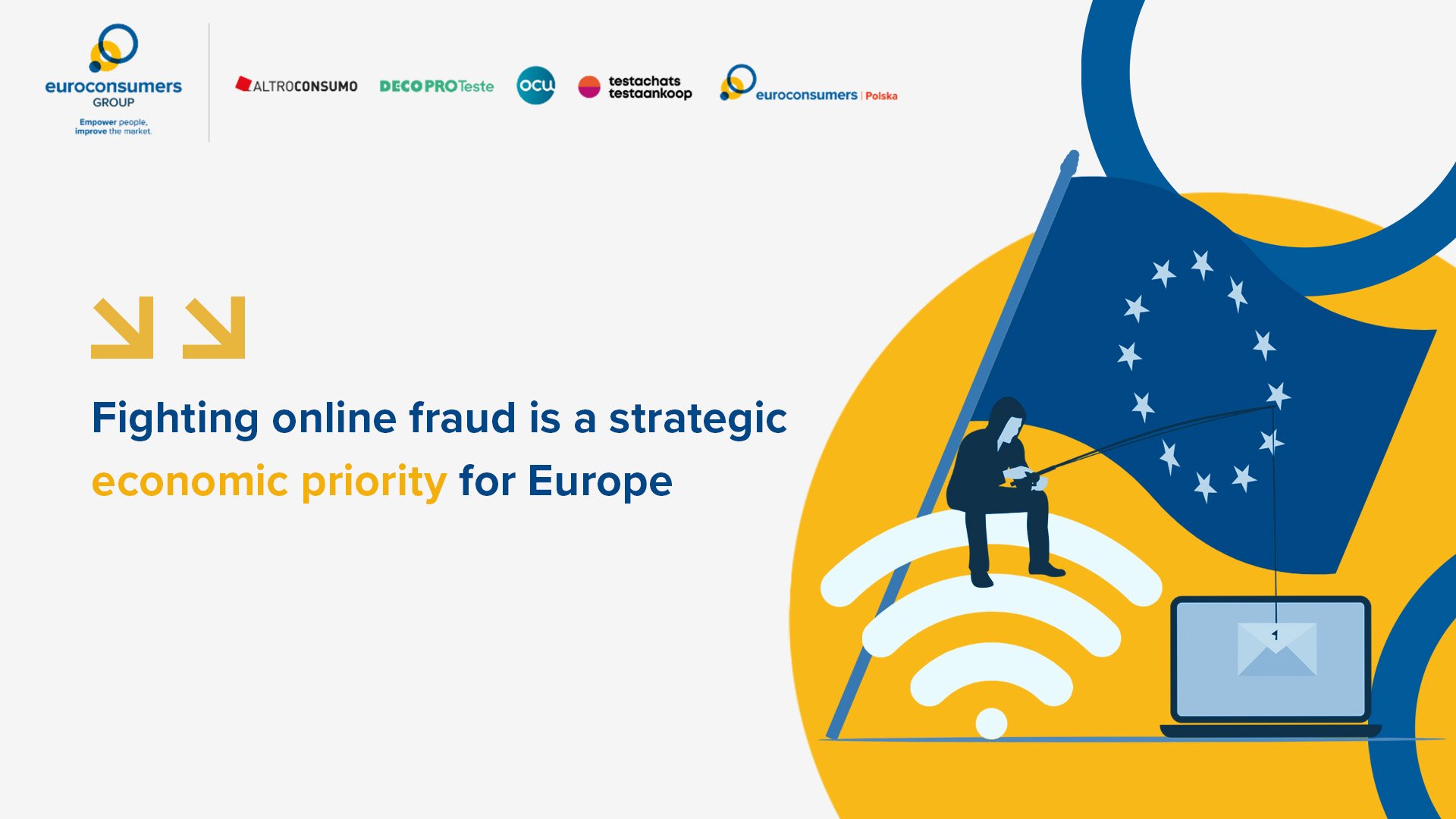
Fighting online fraud is a strategic economic priority for Europe
Online fraud and scams are recognised as a crime with devastating financial and emotional consequences for individual victims and businesses. But the much bigger economic impact has not so far been given the attention it needs.
Speaking on a panel at the Euroconsumers Forum 2025, the Global Anti‑Scam Alliance and the European brands association AIM noted that while an exact figure is difficult to determine, they estimate that fraud costs consumers and businesses billions of euros each year.
Criminal networks are profiting from organised, cross-border, system wides cams and fraud, siphoning off resources so urgently needed by the European economy to invest in the green and digital transition.
Euroconsumers knows that consumer protection and competitiveness are mutually reinforcing goals. Rising to the challenge of tackling prolific levels of online scams and fraud is just one example of how protection and prevention is an enabler of, and not a barrier to, growth.
We need to flip the script: prevention and enforcement are not only about consumer protection, they are about competitiveness and growth.
A new perspective on fighting fraud and scams
Given the industrial scale of online fraud and scams and its drain on the economy, it is time to change perceptions of the crime and rethink how to tackle it.
Scams are not about unlucky or vulnerable individuals getting tricked, they are a concerted, sophisticated effort by international criminal networks using all the tools at their disposal to manipulate people and businesses into parting with funds at a massive scale.
Viewed from this way, it’s obvious that this cross-border crime needs a co-ordinated, multi‑state, cross‑sector effort for successful prevention and enforcement.
Speaking at Euroconsumers Forum late last year, the European Commission recognised that it is a “problem that is cross-border, that is global and we need to reflect this inside the commission as regulators”. Directorates working on online fraud include DG HOME, DG JUST and DG CNECT, and co-ordination with DG FISMA and EUROPOL.
A fraud and scam response that matches the global challenge
Other key features for a response that adequately matches this challenge include understanding the importance of individuals. People’s distressing experiences of fraud can also be a vital asset for authorities by providing key evidence for identifying actors, patterns and new forms of fraud.
However, poor victim support and persistent, pejorative attitudes towards losing money to this crime mean the majority of scams and fraud go unreported. This equates to money unrecovered, evidence for enforcement lost and an easier ride for criminals.
Centralised national fraud hotlines for all consumers
Euroconsumers and the Global Anti-Scam Alliance have made a joint call supported by a full analytical report for national hotlines to be established to provide a straight forward, centralised point of contact for scam victims. Having centralised contact points for victims could in turn help facilitate coordination across different countries and stakeholders.
Understanding the scam ecosystem for better prevention
A rethinking of prevention strategies is also well overdue. Here, there is a key role for consumer awareness and knowledge, but the individual should not be the primary focus of efforts. The context of the current online scam ecosystem and the way in which it facilitates crime must be understood when designing defences against fraud.
For example, our Italian member, Altroconsumo, made a formal complaint against booking.com, for failing to protect users’ personal data and for exposing consumers to recurring scam incidents.
Fraudsters rely on a network of digital platforms that carry fake adverts, enable impersonation and payment payment systems that ultimately move illicit funds. If these systems and platforms were to embed anti-fraud measures by design, it would limit the opportunities to enable scams. If they don’t they will continue to facilitate scams.
How the Action Plan on Online Fraud can help change the game
Establishing effective and system-wide scam prevention, enforcement and recovery as part of digital market infrastructure, would protect consumers from criminal harm, and keep billions of euros in circulation.
That’s why we have argued for frauds and scams to be classed as a strategic economic priority in the new Consumer Agenda 2030, with a dedicated policy stream and measurable objectives that cut across digital, financial and consumer protection policy.
Specifically, Euroconsumers wants to see these measures included in the Action Plan on Online Fraud promised in the Consumer Agenda and due in 2026:
- Clarification on the obligations and liabilities of the different stakeholders across the scam chain, including proactive detection, scam takedown obligations, and escalation processes.
- Coordination of victim assistance and redress frameworks across Member States.
- Stronger cross-border enforcement cooperation and data sharing capabilities.
- Funding for targeted public awareness and scam resilience campaigns, with a special focus on vulnerable groups, including the elderly and young people.
- Integrates scam prevention into broader Single Market and SME strategies, recognising the distortionary impact of unchecked fraud on competition, innovation, and digital participation.
When it comes to enforcement, we want to ensure that regulatory enforcement bodies are adequately resourced and capable of taking coordinated action. We also want the enforcement of the EU’s digital rulebook to be strengthened, for example:
- Effective implementation of the GDPR, Digital Services Act, Digital Markets Act, AI Act, and the Payment Services Regulation once it is adopted.
- Introduce additional anti-fraud obligations and liability measures for online platforms, search engines, and electronic communication providers if existing measures prove insufficient to deter or prevent online fraud.
Fight fraud for European growth
Fraud prevention and enforcement are inseparable from European competitiveness and its ability to hit green, digital and industrialisation targets.
Euroconsumers’ organisations will continue to work to improve consumers’ scam knowhow, but the scale of the online fraud challenge requires a lot more than awareness campaigns – it needs a co-ordinated EU strategy that includes robust enforcement, shared stakeholder responsibilities to end the current path scammers take and accessible support services for victims in place.
Let Europe be the first region to recognise online fraud as integral to its economic resilience and digital competitiveness and fight back on those terms.
You can check out our full position in the Response to the Call for Evidence of the European Commission submitted this February.
Share:


