
News
24.03.2026


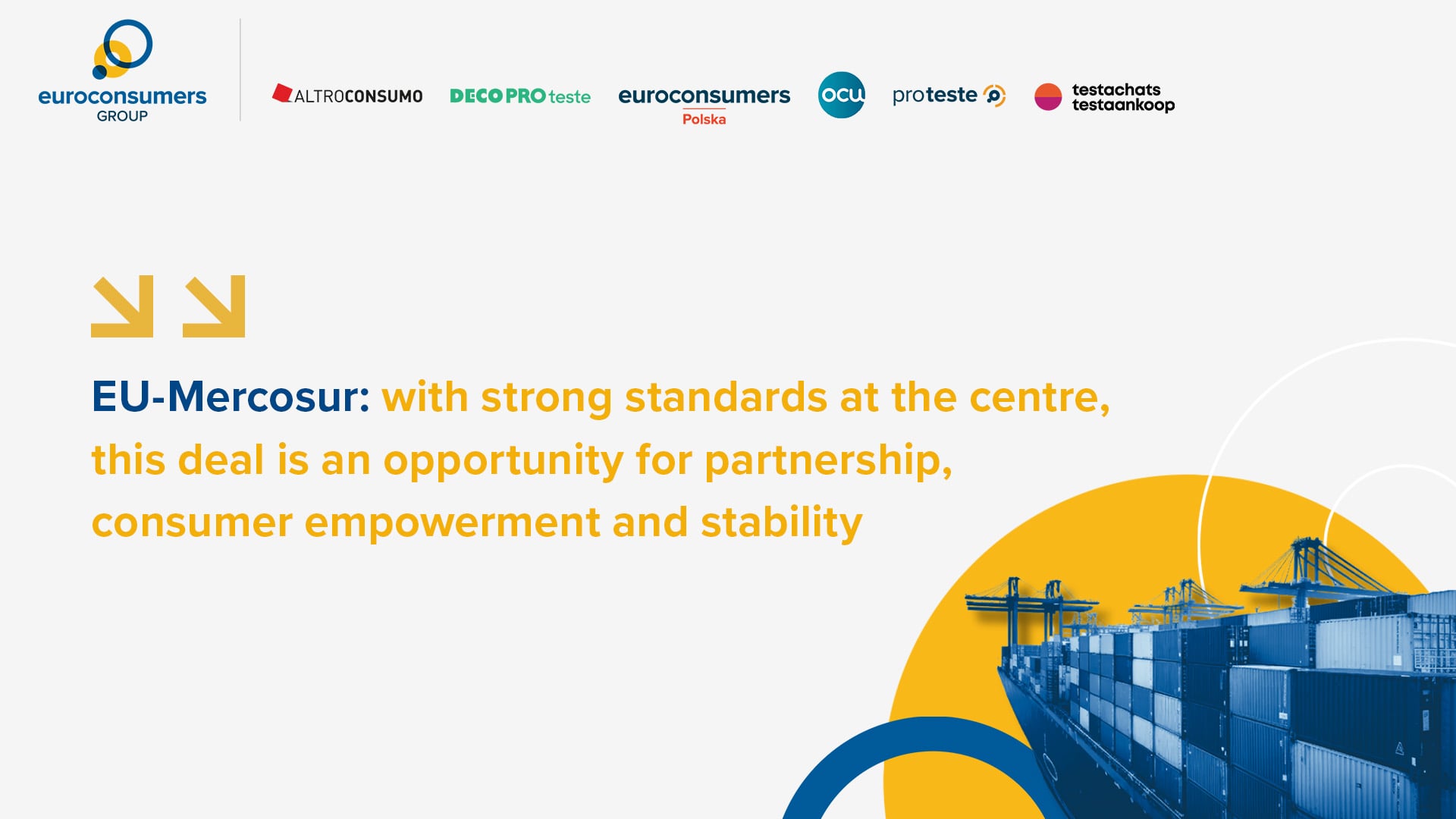
The EU’s trade deal with the Mercosur countries in South America including Argentina, Brazil, Paraguay and Uruguay will be provisionally implemented tomorrow.
As of the 1st May 2026, EU and Mercosur will be a free trade area, with the removal of tariffs on 90%of European exports. The remaining 10% which includes duties on automobiles will be phased out more gradually.
The interim agreement will remain in force until the full trade deal is formally ratified, allowing long-negotiated changes to be implemented after more than 25 years of talks.
There’s been opposition along the way since talks started in 1999, but by creating the largest free trade area in the world, Euroconsumers says the EU has scored some big wins on both the geopolitical and consumer supply chain front. However, good outcomes for consumers will depend on successful implementation.
Earlier this year, Euroconsumers set out why it supports the EU–Mercosur agreement, describing it as a pragmatic instrument which can build resilience for European consumers through a number of outcomes:
But Euroconsumers sees beyond these tangible benefits for consumers, towards a critical new phase in Europe’s trade policy which could reinforce consumer protection and extend EU standards globally through the ‘Brussels effect’:
Instead of assuming weaker consumer protection, well designed trade deals can actually strengthen consumer protection as imports must comply with gold standard EU legislation like product safety, traceability and sanitary control.
With consumer coverage of over 700 million people in two continents, this then significantly extends EU standards of safety, labelling and quality across supply chains through regulatory alignment.
Els Bruggeman, Head of Policy and Enforcement, Euroconsumers
Trade depends on consumers’ trust in the products being placed on the market. In practice, this means clearly demonstrating that the goods meet independently verified standards, removing any doubt about their safety and quality.
The Mercosur agreement has provisions that should strengthen the traceability and market surveillance mechanisms that help ensure imports comply with EU legislation including quality controls and border inspections.
Euroconsumers will work with EU institutions, regulators and stakeholders to actively monitor the implementation of these provisions to ensure they are fully upheld as the deal comes into place.
Something bigger is going on here too. The economic and political shocks of the last decade have made consumers far more aware of how supply chains works . From Covid to fertilizer blockades to energy price surges, consumers have had to get to grips with how global conflicts play out in almost real time at the check out.
And consumers are now painfully familiar with ‘rocket up, feather down’ pricing where downstream prices respond differently to upstream changes and so embed household budget deficits and leave little to no headroom for savings or safety nets.
Euroconsumers’ recent study of 10,000 people across Belgium, Denmark, France, Germany, Hungary, Ireland, Italy, Poland, Portugal and Spain got their views on trade wars, geopolitical tensions and rising costs.
After several turbulent years, many now have strong expectations for political and economic leadership from Europe that will deliver stability and predictability. Consumers as geopolitical actors: What Europeans expect from the EU in a disruptive world found:
Consumers want international trade — but they also want reassurance that the EU will export its reputation for consumer protection and quality.
The survey reveals that European consumers are not just passive observers of geopolitical shifts: through their choices, their trust and their everyday behaviour, they know they have a role in shaping markets and market power.
Of course, trade only works if people trust it and so implementation of the agreement must be closely monitored to make sure adherence to these protections are fully upheld in practice, not only inscribed in treaty text.
Consumers’ support for strengthening ties with a more diverse set of partners to counteract reliance on a now erratic ally, and doing so in a European way built on fairness and high standards is one that policymakers cannot afford to miss.
Euroconsumers welcomes the EU-Mercosur deal as a practical move and as a symbol of how Europe can assert its economic and political strength through partnerships and alliances. Trade agreements therefore are not just about access to markets, they are about the European Union’s place in the world.
Share:


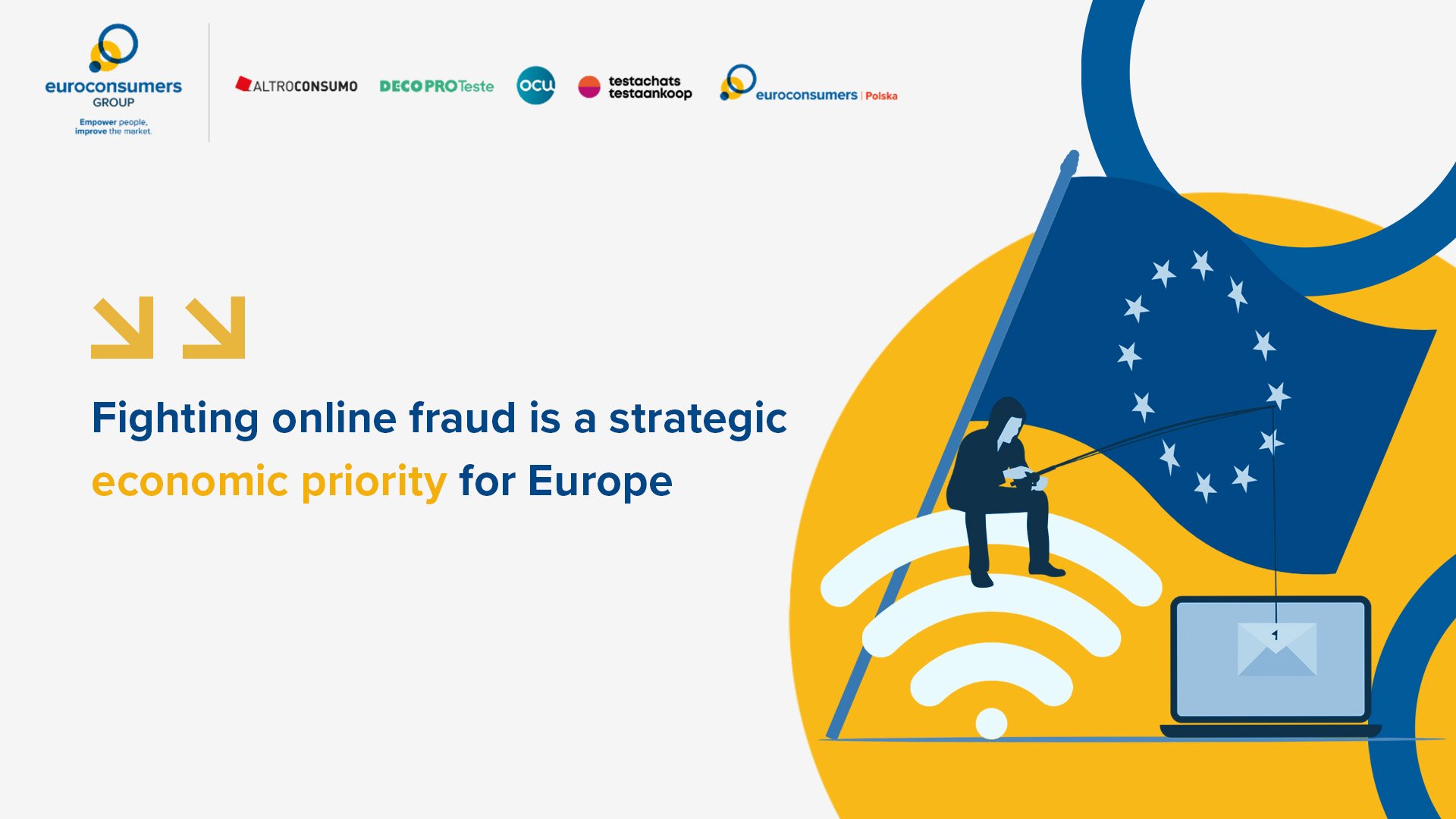
Defeating fraud goes beyond consumer protection, it is integral to Europe’s economic resilience and competitiveness.
Random product testing finds widespread and alarming failures in children’s products, home electronics and jewellery - from choking hazards to fire risk and toxic metals.
Read More