Marco Scialdone, Euroconsumers’ Head of Litigation spoke at the closing event of DEUCE, an innovative new EU initiative which is designing ways to make it easier to actually enforce court decisions across different countries when money is owed.
European consumers have more rights than ever before – but rarely get the compensation owed to them when harm occurs.
Here we share his take on how we got here and how a digital enforcement toolkit could turn hard-won legal promises and rights into real, accessible redress for consumers:
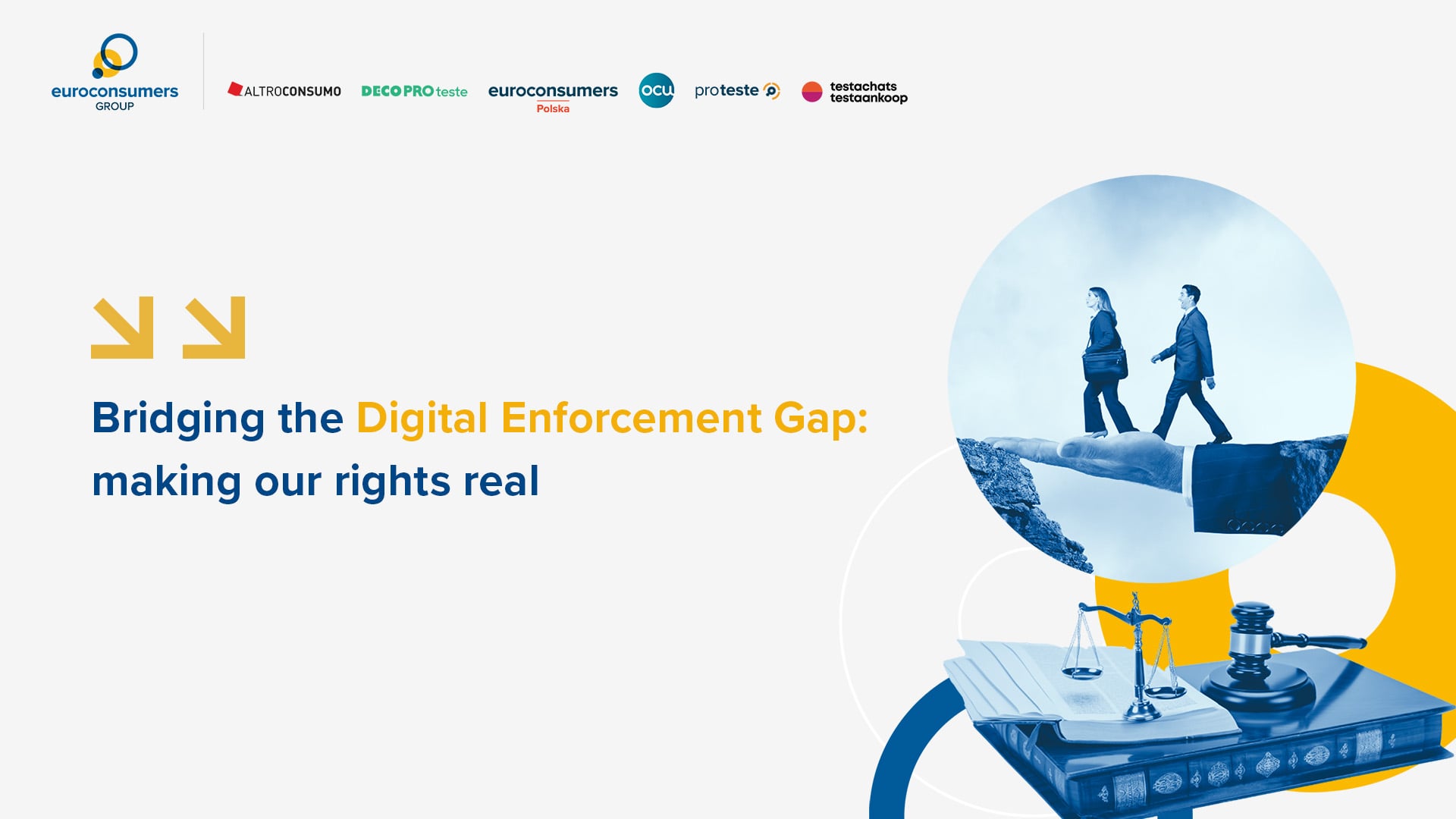
1. Bridging the digital enforcement gap: turning rights into reality
The digital environment has empowered individuals and reshaped our public and private lives with unprecedented access to information and choices. But this transformation has been accompanied by downsides and harms that have slowly been addressed by developing new or adapting existing regulations.
Since 2016, there has been an explosion in digital rights for consumers across the EU. But paradoxically, this golden age of regulation exists alongside the dark age of enforcement – where consumers feel less in control and the process of getting those rights realised through enforcement is frustratingly slow or non-existent.
We end up with an enforcement gap – the hollow space between the promises made by law and the actual reality of the user experience.
2. The evolution of the digital persona: the “Cristiano Ronaldo” paradigm
Starting to address this gap begins with redefining who a consumer in 2026 is.
The modern digital consumer is no longer just someone making a monetary transaction; they are anyone interacting with digital content or services. This shift is defined by the commodification of digital identity, where personal data has moved from being a simple privacy concern to a primary economic asset.
We can view this through the “Cristiano Ronaldo” Paradigm – named for a footballer who is both an individual subject and a brand asset. In the digital economy, every consumer functions in a similar way, but perhaps not as lucratively, as both a subject and an asset:
- • As a subject: a consumer is a human being with a name, a private life and inalienable human rights protected by law.
- • As an asset: a consumers’ digital footprint and preferences represent equity, a patrimonial asset capable of generating immense economic value.
In this landscape, your data functions as a “counter-performance” where it is essentially the price you pay for “free” services. This highlights the economic value of your information, but it does not reduce you to a commodity. Instead, it emphasizes that you remain the “owner” of your rights even when your data is used to generate profit.
This paradigm also helps us to think differently about what constitutes a harm, and to understand that harms go beyond financial loss into things like personal loss of autonomy and control
3. The roadblocks in public enforcement
If our rights are so clearly defined, why is the enforcement gap widening? Why are consumers unable to uphold their data rights or receive compensation for when they are breached? The answer lies in systemic failures within public enforcement at every level:
- • Lengthy and cumbersome procedures: digital markets evolve rapidly, but coordinated enforcement actions often take so long that the technology has moved on by the time authorities act.
- • Inconsistent national capacities: there is a vast disparity in how different EU member states interpret and apply consumer rules.
- • The “watchdog” problem: Consumer organisations like Euroconsumers and its national members are essential “watchdogs” for digital rights, but our impact is limited when national authorities lack the resources or responsiveness to act on our findings.
- • Application volatility: application of the law can be erratic. For example, the Italian Antitrust Authority dismissed a case against Bing Chat for AI “hallucinations” in 2023, yet initiated a case against Deepseek for similar issues only two years later.
- • Technical gaps: many authorities simply lack the IT and AI experts necessary to detect 21st-century legal infringements.
4. The labyrinth of private redress
When public enforcement fails, consumers must turn to private enforcement, and here it is opt-out collective redress that promises the most effective route. The Representative Actions Directive (RAD) which was transposed into national legal systems in 2023, was designed to allow qualified entities to bring collective actions on behalf of consumers to protect their collective interests.
However, the reality falls short of the goal.
There is currently no unified European class action; instead, we have 27 different national regimes. Even when a national regime is opt-out for its own citizens, it remains opt-in for consumers from other EU countries.
This creates a fragmented labyrinth that is nearly impossible for consumers to navigate.
Furthermore, the RAD does not currently cover antitrust cases, leaving consumers vulnerable to the effects of cartels and market dominance.
5. A digital enforcement toolkit for the future
We cannot solve technical problems with purely analog solutions. We need a strategic toolkit that includes:
- • Technical solutions like Regulatory Technology (RegTech): we must empower independent third parties to conduct algorithmic auditing and use AI to monitor other AI systems, automating the detection of “dark patterns” and biased outcomes. Supporting changes to mechanisms that support enforcement, such as the Intelligent Interface Design tool developed by DEUCE to standardize the process for reclaiming funds is also essential.
- • Broader powers for representative actions: we must integrate competition damages into the RAD to give consumers a tool against market dominance, which is a common feature in digital markets.
- • Stronger representative actions: we need a mandatory, EU-wide opt-out regime and the introduction of statutory damages. Since proving exact financial loss from a digital “dark pattern” is nearly impossible, statutory damages would provide a necessary shortcut to justice.
- • Resources and funding for qualified entities in representative actions: bridging the enforcement gap is only possible if consumer organizations have the resources to do it. We need consistent public and private funding to ensure that qualified entities can match the scale of the digital market.
6. Towards restorative justice
Perhaps the most powerful shift will come from redefining harm and redress for the digital economy.
This starts with moving from the idea of corrective justice with its focus on fixing individual past transactions towards restorative justice which understands we are all part of a digital commons whose health depends on repairing and nurturing the systemic relationship between the market and the community.
With restorative justice as a guiding goal, we can rethink and redefine harm, recognising that the “loss of control” over one’s data is a compensable injury in itself.
In a digital world, you do not need a drained bank account to be a victim; the loss of digital autonomy is a wound that requires legal healing. Tending to injuries in this way, reinforces the future health of our digital commons, and improves relationships between all its parts.
From rights on paper to power in consumers hands
We already have the rights on paper; now, we must work together to make them a reality in our daily digital lives.
Through initiatives like the Re-act pilot project, Euroconsumers is testing out how the RAD can be leveraged to bring collective actions on behalf of consumers who have suffered when companies have failed to follow the rules of the Digital Services Act (DSA).
It is vital that the EU continues to support initiatives like Re-act which will strengthen the capacity to obtain collective redress and restore justice.
We must also all learn from groundbreaking collaborations like DEUCE, which are pulling together experts to streamline core aspects of enforcement so that compensation reaches intended beneficiaries and creates the expectation of enforcement as the norm and not the exception.
The road toward a fairer Digital Single Market depends on these ongoing collaborative efforts to ensure that rights on paper become rights in practice.