
News
21.05.2025
Tariffs add to consumers’ financial fears
Euroconsumers took the consumer temperature on household finances and upcoming tariffs and found widespread worries
Read More


Alongside the suffering and uncertainty of citizens across the Middle East, the escalating conflict between Iran, Israel and the US is now directly impacting international energy markets. Since late February, there has been a rapid, sharp rise in wholesale gas and electricity prices.
Key oil and gas facilities across Gulf states have been damaged including strikes on a major liquefied natural gas (LNG) production base in Qatar.
Continuing threats against oil tankers in the Strait of Hormuz have effectively cut off this vital supply route. This channel carries a fifth of the world’s oil and gas supply, so any disruption here has far reaching economic consequences.
Despite moving towards greater energy independence since the Russian invasion of Ukraine in 2022, the EU still relies on energy imports from other countries which makes it vulnerable to global energy disruption.
For example, Europe has replaced Russian gas imports with LNG imports – 6% of which come from Qatar via the Strait of Hormuz.
Commission decision makers came together last week at a leaders summit where the energy crisis is top of the agenda and are considering targeted measures like price caps or loosening restrictions on state aid.
Euroconsumers members are already seeing consumers’ bills rising at the petrol station, and fear rising home energy bills are just around the corner. This is worrying as we know from previous energy price crises that once prices go up, they tend not to return to previous levels even after conditions stabilize.
Our members in Italy, Belgium, Portugal and Spain have shared their perspectives on what’s happening in consumer markets and how they are stepping up to help consumers:
Italian member Altroconsumo has found the average price of petrol and diesel has increased by at least 3% since the start of the conflict, with peaks of almost +6% for diesel between 25th February and 5th March.
Consumers are already feeling the impact of these increases, even though they are largely pre-emptive and not yet supported by any real shortage of refined products on the market.
The official price observatory has found a few examples of some distributors potentially even exploiting the crisis to price fuel higher than necessary. While these are isolated incidents, the general pattern of price rises across suppliers is of great concern.
Italy has taken a proactive stance on price speculation, with the government holding weekly meetings to monitor energy price movements and preparing plans to curb any speculative behaviour should it emerge.
The government adopted measures that include the recalculation of excise duty rates on gasoline, diesel, and LPG starting March 19th for 20 days. The goal is to reduce the price of gasoline and diesel at the pump by 25 cents per liter.
Euroconsumers Spanish member OCU has observed an increase of around 80% in gas prices from certain suppliers, with an upward swing from €30/MWh to more than €50/MWh.
If this trend continues, the average monthly price of gas could reach around €100/MWh, which translates into an average electricity bill of €82, compared to €63 in February – in other words, a 30% increase in a single month.
Consumers will feel these rises at different times, depending on the set up of their current energy supplier contract. OCU says that Spanish consumers on indexed rates will feel the increase first, those on PVPC tariff (which calculates rates over a longer time period) or fixed-price rates will see a more gradual impact.
OCU recommends consumers compare offers and review their contracts to prepare for any changes. OCU will be monitoring market developments and advocating for measures to protect consumers against this latest wave of energy volatility, including continuing calls for a reduction in VAT on fuel. Drivers can use the OCU comparison tool to find the cheapest petrol station.
In Belgium, Testachats/Testaankoop recorded gas prices rises of around 85% since the first weeks of the conflict.
But the organisation also points out that with milder weather on its way, price increases may have less of an impact on total bills.
The longer outlook is more concerning though. Now in its fourth week, many fear the conflict is likely to last a while and so expect disruption and price instability to continue. Gas stocks are also at a lower level than in previous years meaning more imports will be needed, adding yet more pressure on prices.
Testachats/Testaankoop’s practical advice for consumers is to wait until the end of March to decide whether it’s worth switching to a fixed contract or not. They are publishing a monthly analysis of fixed price contracts based on the tariff cards that suppliers release at the beginning of each month.
Our member in Portugal, DECO PROteste has warned that the escalation of the conflict could cause further rises in fuel, electricity and gas prices in Portugal.
They are calling for a structural reform of taxation on vehicle fuel in the form of a mechanism that reduces the tax on fuel when the prices of raw materials rise and then increases it when they fall – this gives consumers steadier and more predictable prices at the pump fuels protects them from price fluctuations.
They also want the VAT on bottled and piped gas to be reduced to 6%, to bring it in line with taxation on other essential energy products like electricity and natural gas.
DECO PROteste is also publishing a monthly index of electricity and natural gas prices.
Energy price hikes will add pressure to households already struggling with costs. Euroconsumers Consumer Affordability Barometer showed that basic utilities are a significant financial burden: across Belgium, Spain, Italy and Portugal, 37% of consumers said they found paying for essentials like gas, electricity and water essential difficult or rather difficult to afford.
And of course, rising wholesale prices will not only hit individual transport, heating and lighting bills, it impacts business and manufacturing costs, and so we can expect to see broader rises across already stretched consumer budgets.
The annual survey for 2025 also found many families living paycheck to paycheck with no financial safety net to cushion them from unexpected events like the Middle East conflict which can suddenly drive up the price of everyday goods and services.
Euroconsumers and its members will be with consumers all the way through the crisis, with information and advice on prices and advocating for measures which can offset some of the short term costs pressures, like the reduction of VAT on energy. However, structural change is needed to disrupt the cycle of price instability.
Delaying Europe’s energy market reform is no longer an option. The war in Ukraine brutally exposed the risks of relying on imported energy. The EU’s renewed exposure to supply shocks underscores how its dependence on external supplies leaves it vulnerable to often volatile global markets.
Strengthening an integrated energy grid and single market, as outlined in the 2025 Grids Package, and rapidly scaling up domestic green and clean‑energy production are essential steps towards independence and sovereignty over our energy choices and prices.
Share:


Euroconsumers took the consumer temperature on household finances and upcoming tariffs and found widespread worries
Read More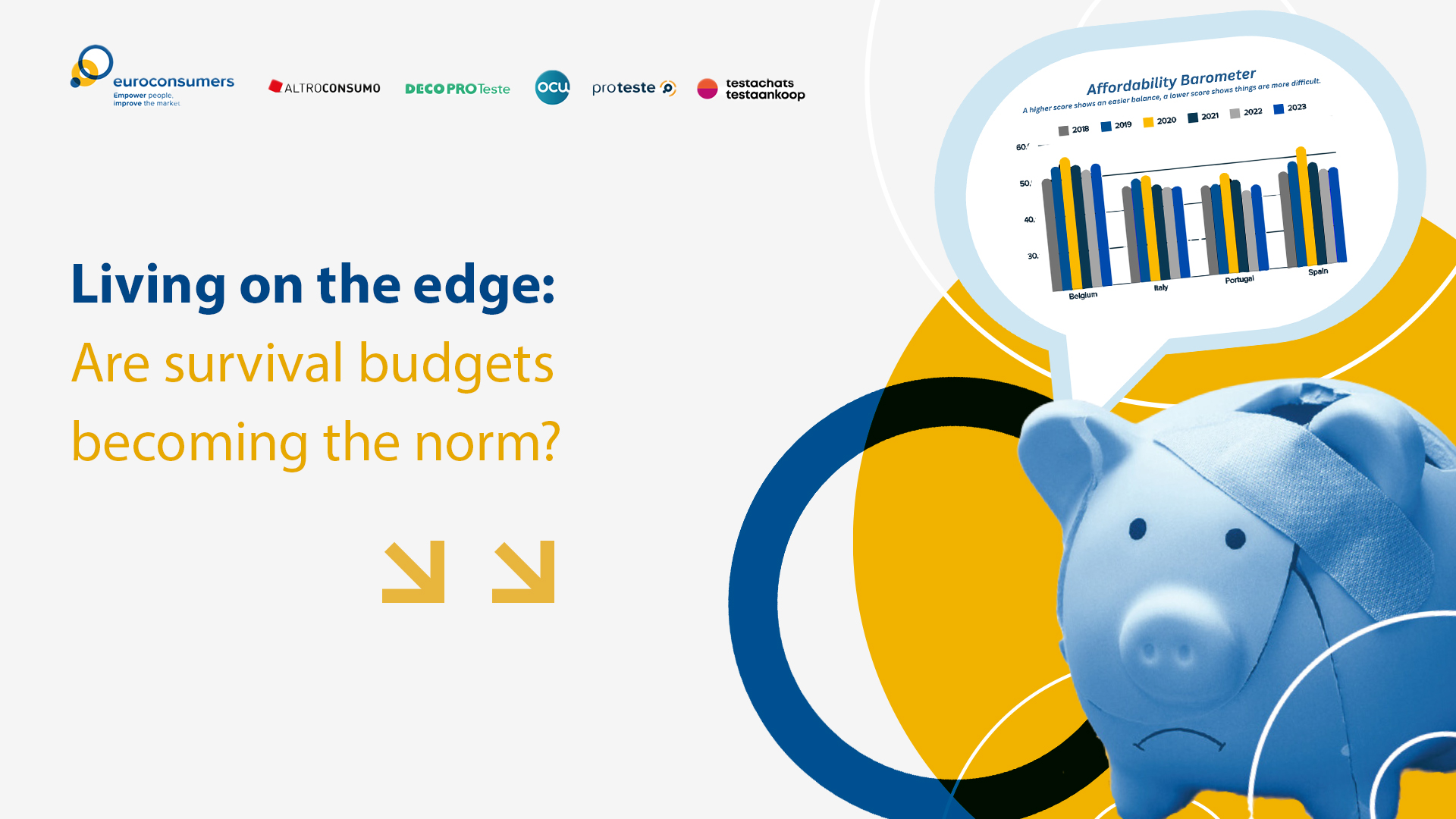
Euroconsumers Consumer Affordability Barometer 2024 has a loud, clear message for the EU - make our lives more affordable.

After the Iberian blackout, Euroconsumers, OCU and DECO PROteste want an Energy Grids Package that delivers a resilient, interconnected system that consumers can rely on.