The EU wants to be a world leader on the circular economy in just four years’ time. The proposed Circular Economy Act has set out a plan to create a Single Market for circular materials and goods, one that stimulates supply and demand across the entire region.
This will require a major shift in centuries-old production and consumption methods and supply chains. The proposed Act is ambitious, but does it provide enough support for consumers to actively choose circularity?
A competitive circular Europe needs empowered consumers
The Act offers an excellent opportunity to energise and empower consumers to participate in the transition so they can benefit from longer‑lasting, repairable products, a trustworthy repair ecosystem and be confident that their choices support the environment.
However, while consumers are included in the proposal, Euroconsumers want to see stronger, more explicit policy moves that recognise the central importance of consumers to making circularity a reality.
Why? Because a thriving circular economy relies as much on confident, informed consumers as it does on innovative, competitive businesses. People who understand and trust the benefits of circular products and services will generate levels of demand that rewards fair competition and accelerates sustainable innovation.
Circular consumer demand will drive business innovation
Fulfilling consumer demand also encourages businesses to reduce their reliance on scarce resources, and creates value by keeping materials circulating within the EU economy rather than being lost to waste or exports.
Euroconsumers’ consumer research and hands-on, multi-country, cross-sectoral projects have taught us a lot about what motivates and what holds back consumers from committing to circular behaviours. And our work with repairers, retailers and manufacturers has shown the barriers that they face in delivering circular products.
Cost, accessibility, trust and clear information remain the decisive factors. Our initiatives across Italy, Spain, Belgium and Portugal provide evidence of what works — and where barriers persist.
Based on this extensive and practical knowledge, here’s what we would like to see embedded in the Circular Economy Act to create a transparent, reliable and fair system for both consumers and innovators:
1. Enable a thriving refurbishment market and establish a Single Market for circular consumer goods
Refurbishment offers huge potential for consumers, the economy and the environment: it keeps products in use longer, meets growing consumer demand for affordable alternatives, and generates business opportunities across multiple sectors.
More is needed to reassure and encourage consumers to buy refurbished. Our research report How Good is ‘As Good as New’? found that while over half of consumers are open to buying refurbished goods, inconsistent definitions and variable quality undermine confidence.
This plays out in Euroconsumers’ members’ product tests. When Testachats examined 44 refurbished iPhone X and 11 models sold as “as good as new” in 2022, only two met the expected minimum score for this classification.
Addressing the need for clear standards and reliable information through legislative initiatives would build consumer confidence and stimulate demand for refurbished products.
We recommend:
- • Defining “refurbished” separately from second-hand and harmonising minimum warranty durations.
- • Adopting EU-wide grading standards, with transparent criteria for refurbished products.
- • Broadening the range of product families subject to eco-design requirements.
- • Providing simplified certification and registration schemes
- • Ensuring fair competition by enforcing compliance across large and small actors.
2. Empower consumers through Digital Product Passports
Digital Product Passports can enable consumer participation in circular value chains by providing clear, actionable information on repairability, spare parts availability, refurbishment history, software support and recyclability.
The CIRCTHREAD project, involving Euroconsumers’ members, Altroconsumo and OCU, surveyed nearly 6,000 consumers across multiple EU countries to find out their views on Digital Product Passports.
They found accessible, item-level, verifiable data empowers consumers to select repairable or refurbishable products, return items for reuse and contribute to proper recycling.
We recommend:
- • Requiring DPPs to include refurbishment and repair history, spare-parts availability, repairability score, software support period, grade, warranty and recyclability information.
- • Ensuring DPPs are accessible to consumers, interoperable for SMEs, and available both online and offline.
3. Strengthen repair rights and affordability
Repair is the most direct and visible form of circularity for consumers. It saves resources, saves money and prevents waste but consumers still face multiple barriers.
Repairs often cost more than replacement. But even if consumers are aware of repairability options, spare parts, manuals or trusted, qualified repair services are hard to find. This can all feed into consumer scepticism towards repair services, as consumers struggle to understand and compare their options.
Euroconsumers’ members OCU, Altroconsumo and DECOPROteste are part of the REPper project aiming to change people’s perspective on repair.
They’ve established a set of key needs to make repair as a default consumer choice including financial and policy incentives; skills and infrastructure; and encouraging consumer engagement through better market practices and pricing and challenging the ‘upgrade culture’.
We recommend:
- • Guaranteeing opens access to spare parts, diagnostic tools and repair information.
- • Reducing VAT or use other fiscal incentives for permanent repairs.
- • Promoting repair scoring and transparent pricing across the Single Market.
4. Address software obsolescence
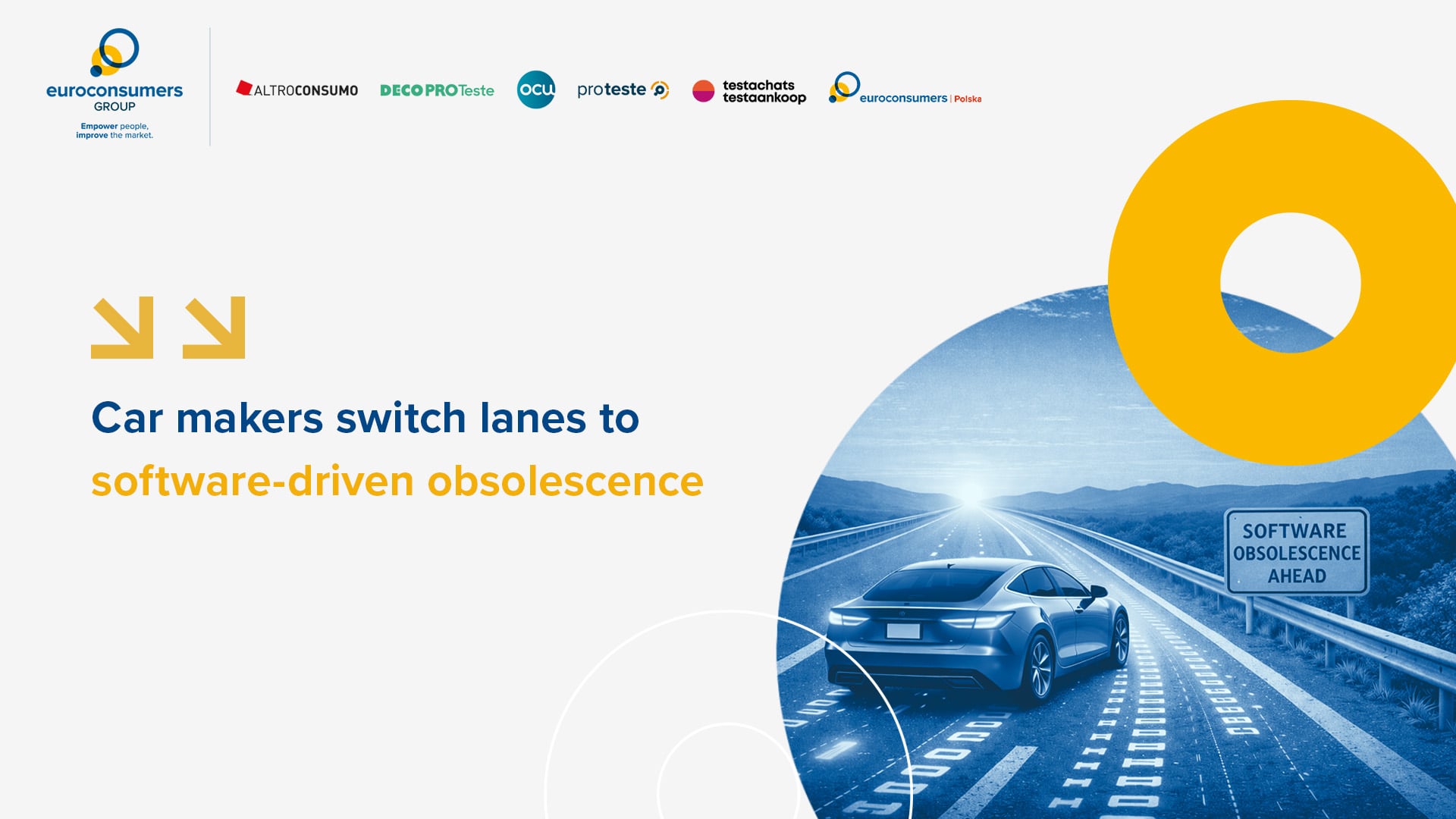
The practice of software obsolescence, where physically sound products are made unusable as software support or compatibility is withdrawn, could undermine the goals of the Circular Economy Act.
This emerging trend which pushes consumers to replace functional devices, and raises doubts about the value of refurbished models threatens to be a major structural barrier to circularity. Euroconsumers’ position paper Software Obsolescence as a Business Model explored this growing practice and how policy measures could disrupt its progress.
We recommend:
- • Requiring minimum free update periods for matching product durability.
- • Obliging disclosure of software support and update status within the DPP.
Include consumer goods into the Circular Economy Act
The clue to developing policy for a circular economy is in the name – all parts of the production and consumption circle must work together. To achieve a truly competitive and resilient circular economy, policy must look beyond waste and secondary raw materials to the consumers goods and patterns of demand that generate them.
With the right conditions in place, consumers will provide a stable demand for secondary raw materials, and for products that can be used over and over for their full lifetime. Responsive suppliers and innovative manufacturers can then be sure of an active market for circular products.
Policy must make circular choices the easy choice for consumers as a competitive circular Europe cannot happen without involving consumers.
That means combining the effective enforcement of existing consumer law with clear, future-proof circular economy rules. Crucially, for the Circular Economy Act, it means making consumer directed policies explicit.
In this way, the EU has the best chance to build a transparent, reliable and fair system for both consumers and innovators by 2030.